
In short
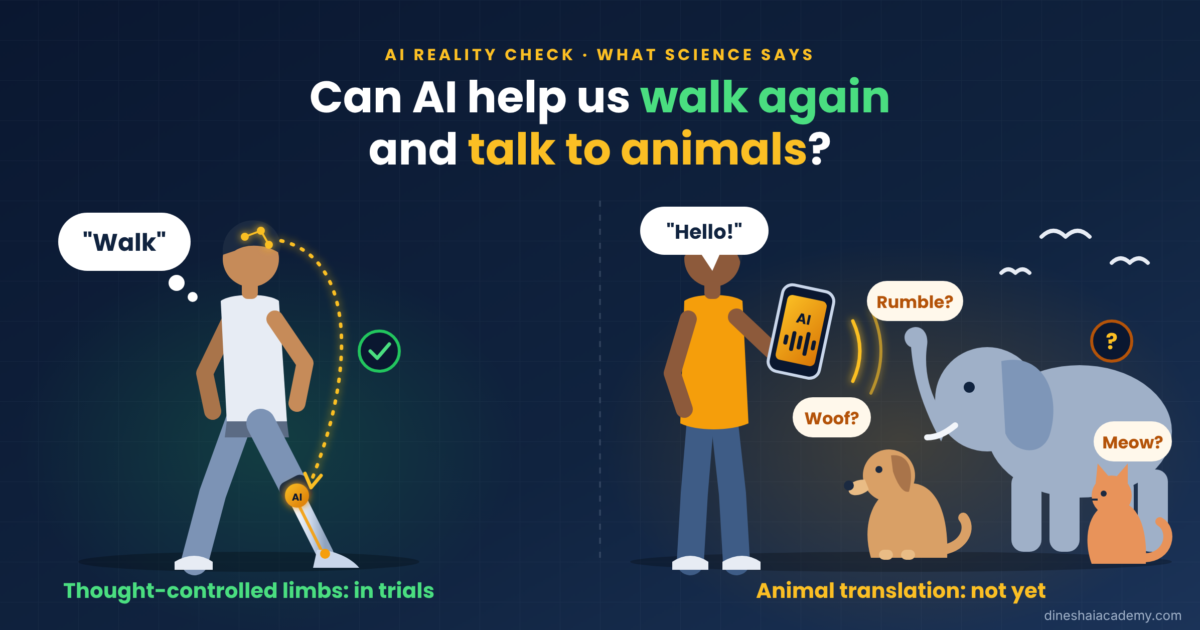
- AI is already helping a small number of paralysed people speak, walk and control bionic limbs in clinical trials. It is real, but still experimental and rare.
- Can AI help us talk to animals? Not yet. It can spot patterns in whale clicks, elephant rumbles and birdsong, but nobody can hold a two-way conversation with an animal today.
- The difference comes down to one thing: a person can tell AI what they meant, and an animal cannot. That missing “answer key” is the real barrier.
In August 2024, a man who had lost his speech to ALS began talking again through a brain implant, with up to 97% accuracy [1]. In April 2026, the scientists studying sperm whales off Dominica, after years of work, said plainly that they still do not fully know the whales’ language [9].
Both projects use the same kind of AI. One is giving people their voices back. The other is still listening. This guide explains why, what is truly possible today, what is in trials, what is still science fiction, and how to judge the next headline that promises a “talking” machine.
Please note: This article is for education only and is not medical advice. The brain and spinal devices described here are investigational and available only in approved clinical trials. Please consult a qualified neurologist or rehabilitation specialist about any personal situation.
The One-Line Insight: why AI can read a brain before it can read a whale
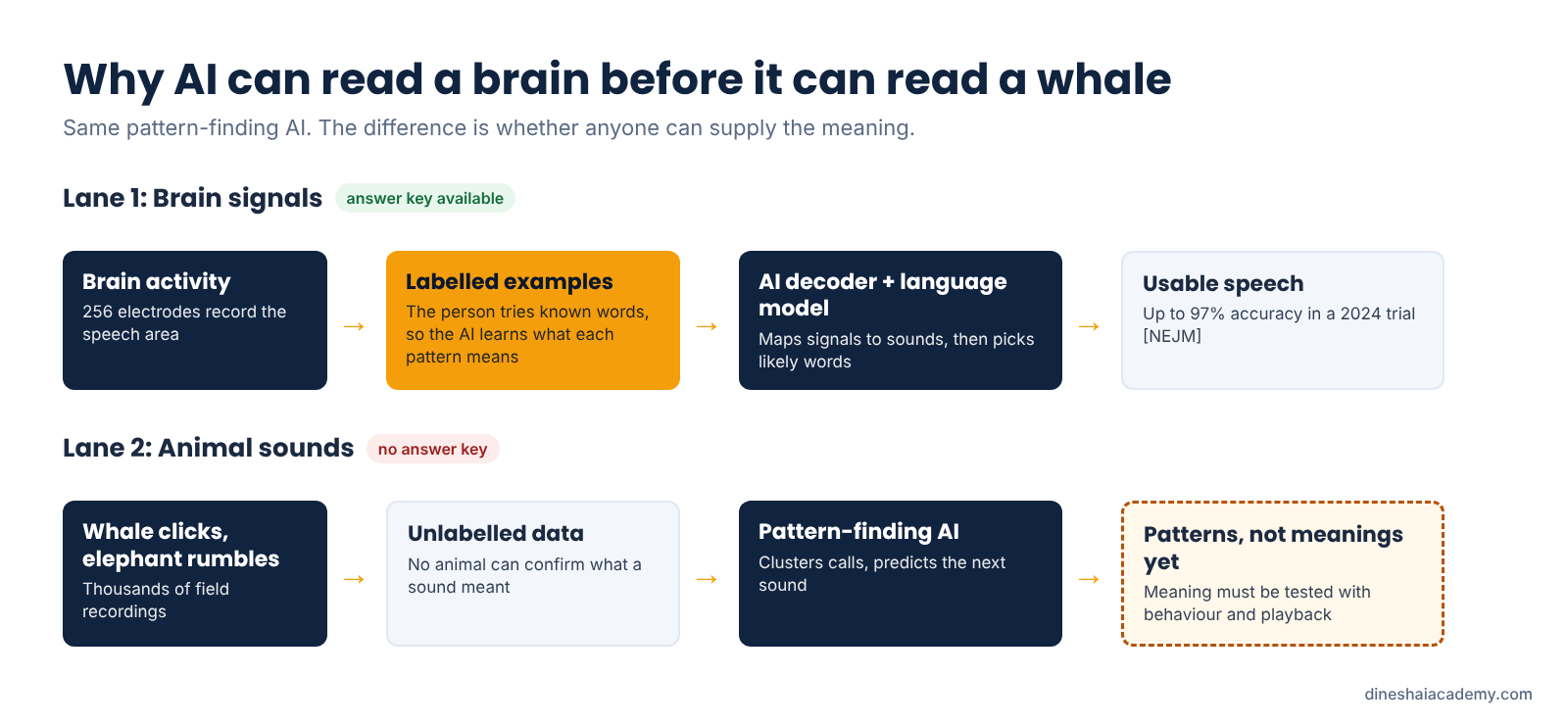
AI turns signals into meaning by learning from examples where the meaning is already known. Brain signals and animal sounds are both signals. The difference is who supplies the meaning.
Think of it as learning a new language with a teacher versus without one. A patient with a brain implant is the teacher: they try to say “water”, the system records the brain activity, and now the AI has a labelled example. Repeat that thousands of times and the AI learns the mapping. A whale offers no such help. It cannot say, “that click meant food.” Scientists have to guess the meaning from behaviour, which is slow and uncertain.
The analogy has a limit. Even with a willing “teacher”, brain signals are noisy and change over time, so human systems need regular retraining. Still, the teacher makes all the difference, and it explains almost everything else in this article.
How AI is helping paralysed people speak, walk and move
A brain-computer interface (BCI) is a device that reads electrical activity from the brain and turns it into commands for a computer, a voice or a limb. AI is the translator in the middle. Here is what the peer-reviewed evidence shows.
Speaking again
Casey Harrell, 45, has ALS, a disease that steadily takes away control of the muscles, including those used for speech. In July 2023, surgeons at UC Davis Health placed four tiny electrode arrays, 256 electrodes in total, in the part of his brain that controls speech [1]. The results, published in the New England Journal of Medicine:
- Fast start. 99.6% accuracy on a 50-word vocabulary in the first session, after about 30 minutes [1].
- Large vocabulary. 90.2% accuracy on a 125,000-word vocabulary once the system had 1.4 extra hours of data to learn from, rising to about 97.5% over time [1].
- His own voice. The decoded words were read aloud in a voice rebuilt from recordings made before his illness [1].
One year later, a Stanford team went a step further. In a 2025 study in Cell, four people with severe paralysis had sentences they only imagined saying decoded with up to 74% accuracy [2]. The team also added a mental password, the phrase “chitty chitty bang bang”, which the system detected more than 98% of the time, so the decoder works only when the user wants it to [2]. That is an early, practical answer to a fair worry: who controls what a brain implant can read?
Walking again
Gert-Jan Oskam was paralysed in a cycling accident and had not walked for 12 years. In 2023, Swiss researchers reported in Nature that a “digital bridge” let him walk using his thoughts [3]. Implants on his brain picked up his intention to move, a computer in a backpack decoded it, and a wireless signal told a stimulator on his spinal cord which leg muscles to activate.
The most hopeful detail came later. After about 40 rehabilitation sessions, he regained some voluntary leg movement even with the system switched off, and could walk short distances on crutches without it [3]. The honest caveats: it was one person, and one implant had to be removed after about five months because of an infection [3].
Bionic limbs that feel like your own
Not every solution needs a brain implant. At MIT, Hugh Herr’s team changed the amputation surgery itself. Their method, the agonist-antagonist myoneural interface (AMI), reconnects pairs of muscles in the remaining limb so they keep “talking” to each other and to the nervous system [4]. In a 2024 Nature Medicine study, seven people with this surgery controlled a bionic leg with their own nerve signals and walked about as fast as people without an amputation [4]. They received less than 20% of normal sensory feedback, yet that was enough to change how they walked [4]. About 60 people worldwide had received the surgery at that time [4].
What the AI actually does. A speech BCI is a supervised learning system. Electrodes produce a stream of activity readings, many times per second. The model learns to map short windows of that activity to likely speech sounds, and a language model then picks the most probable words, much as your phone’s keyboard suggests the next word. The labels come from the user attempting known sentences. Animal-sound models work the other way round: they mostly use self-supervised learning on unlabelled audio. Earth Species Project’s NatureLM-audio connects an audio encoder to the Llama 3.1-8B language model and is trained on millions of audio-text pairs [10]. Google’s DolphinGemma, about 400 million parameters, predicts the next likely dolphin sound in a sequence [11]. Both are excellent at finding structure. Neither is trained on confirmed meanings, because those barely exist yet.
Can AI help us talk to animals?
AI has made animal research faster and sharper. It has not produced a translator. The discoveries of the last two years are real and fascinating:
- Elephants seem to use names. A 2024 study analysed 469 rumbles from wild African elephants in Kenya. A machine learning model could tell from the sound alone which elephant a call was meant for, and elephants responded more strongly when a call addressed to them was played back [13].
- Marmoset monkeys label each other. Researchers at the Hebrew University of Jerusalem reported in Science in 2024 that marmosets use specific calls to address specific individuals [14].
- Sperm whales have vowel-like sounds. Project CETI analysed more than 1,100 whale click patterns, called codas, and found two vowel-like elements, much like “a” and “i” [9].
- Dolphins and zebra finches share meanings. The 2025 Coller Dolittle Prize went to a team that found the first evidence of a possible language-like system in dolphins. The 2026 prize went to a Berkeley scientist whose machine learning “dictionary” sorted zebra finch calls into 11 types with meanings such as hunger and bonding [12].
Now read the fine print. The 2026 prize winner and the prize’s founder both said genuine two-way communication with animals remains out of reach [12]. The whale researchers say the role of their “vowels” in meaning is still unclear [9]. Notice also what the big AI models claim. Neither NatureLM-audio nor DolphinGemma claims to translate animal speech [10][11]. They identify species, count callers and find repeating patterns.
Why so slow? Three reasons:
- No answer key. We cannot ask a whale what a coda meant, so every meaning has to be inferred from behaviour and tested with playback experiments.
- Different worlds. Much animal communication may not map onto human words at all. Some of it is smell, posture or touch, which microphones never capture.
- Our own bias. Humans love to hear words in animal sounds. Careful researchers spend much of their effort proving a pattern is real and not wishful thinking.
The Reality Map: where things actually stand
| Status | Helping people move and speak | Talking with animals |
|---|---|---|
| ✅ Already done | Speech restored for an ALS patient at up to 97% accuracy [1]; walking via brain-spine bridge [3]; nerve-controlled bionic leg [4] | AI identifies species and call types at scale [10]; evidence of name-like calls in elephants and marmosets [13][14] |
| 🔄 In progress | Neuralink had 21 trial participants by January 2026 [5]; Synchron preparing a pivotal trial in 2026 [6]; Courtine’s team testing arm movement [3] | Project CETI mapping whale “vowels” [9]; DolphinGemma and the CHAT whistle system in the field [11] |
| 🔮 Possible next | First full BCI approval, if pivotal trials succeed [6]; decoding imagined speech more reliably [2] | Simple shared signals with dolphins using agreed whistles [11]; better meaning tests through playback |
| ❌ Not possible yet, and why | No full BCI is FDA-approved [6]; results come from very few people; surgery carries infection risk [3] | No free two-way conversation [12]; no confirmed meanings to train on; much communication is non-vocal |
Milestone timeline
| Year | Milestone | Status |
|---|---|---|
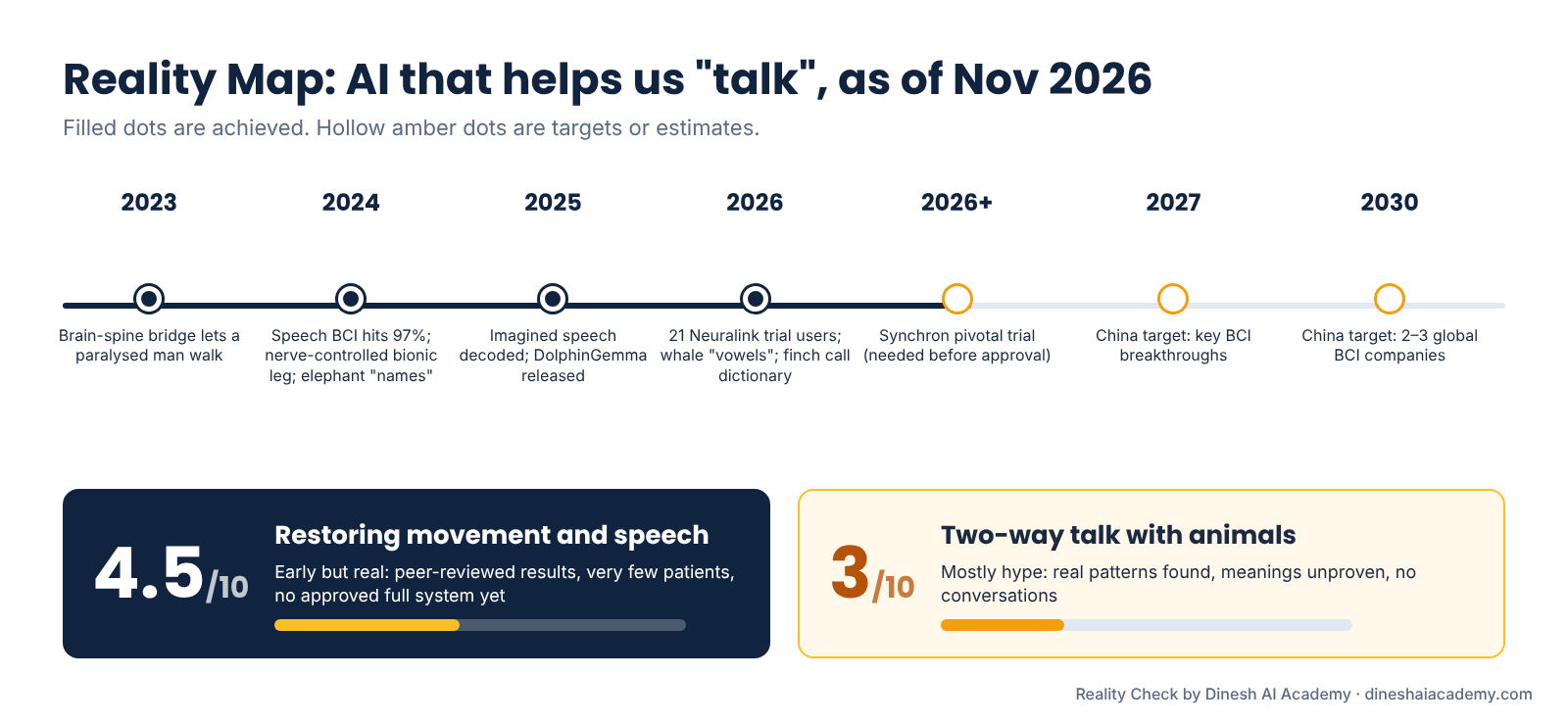
| 2023 | Paralysed man walks with a brain-spine “digital bridge” [3] | Achieved |
| 2024 | Nerve-controlled bionic leg restores natural walking [4]; speech BCI reaches 97% accuracy [1]; elephant and marmoset “names” reported [13][14] | Achieved |
| 2025 | Imagined speech decoded, with a mental password [2]; DolphinGemma released [11]; China sets a national BCI roadmap [8] | Achieved |
| 2026 | Neuralink reports 21 participants [5]; whale “vowels” published [9]; zebra finch call dictionary wins prize [12] | Achieved |
| 2026 onward | Synchron pivotal trial, needed before any approval filing [6] | Announced plan |
| 2027 | China targets breakthroughs in key BCI technologies [8] | Government target |
| 2030 | China aims for two or three globally influential BCI companies [8] | Government target |
| Around 2031 | Project CETI’s founder expects “much more progress” within five years of 2026 [9] | Expert estimate |
Reality Check: how real is it today?
These are two different technologies, so they get two scores. Each factor is scored from 0 to 2.5, based on the evidence above.
| Factor | Restoring movement and speech | Two-way talk with animals |
|---|---|---|
| Research maturity | 2.0: top journals, but tiny groups of patients [1][3][4] | 1.0: real patterns found, meanings mostly unproven [9][12] |
| Real-world deployment | 0.75: dozens of trial users, no approved full BCI [5][6] | 0.25: research tools only, no conversations [10][11] |
| Cost and access | 0.5: brain surgery and specialist centres | 1.0: open models and cheap recorders help researchers [10][11] |
| Rules and safety | 1.25: FDA trial oversight, early safety results met [6] | 0.75: few rules, open questions on disturbing wildlife |
| Total | 4.5/10, early but real | 3/10, mostly hype |
How to judge the next “AI can talk to…” headline
Headlines will keep coming. Use this Signal, Meaning, Scale test to sort real progress from noise in under a minute:
- Signal. Can the system reliably detect the signal, again and again? Spotting patterns in whale clicks passes this test today.
- Meaning. Is the meaning confirmed by behaviour, such as a person confirming the words or an animal responding to playback? Human speech BCIs pass. Most animal claims do not, yet.
- Scale. Does it work beyond one lab, one patient or one animal group, over months? Almost nothing in either field passes this test today, which is exactly why neither is mainstream.
A claim that passes only the first test is a research tool. Passing two makes it a breakthrough. Passing all three makes it a product.
A worked example: one patient’s realistic path in India
Consider an illustrative case. Arjun, 32, a software engineer in Pune, injures his spinal cord in a road accident and loses movement in his legs. His family reads a headline about brain implants and asks if he can have one. Here is the honest picture:
- Today. Rehabilitation, physiotherapy and good assistive devices remain the foundation. The implants in this article are not sold commercially anywhere.
- Near term. Indian research is active. IIT Kanpur has reported a brain-signal-driven robotic hand exoskeleton for stroke rehabilitation, with larger trials at Apollo Hospitals [16]. Its pilot results have not yet been peer-reviewed, so treat them as promising, not proven.
- Medium term. If pivotal trials abroad succeed, approved devices may follow, first in a few specialist centres. Cost and surgical expertise will decide how quickly they reach India.
- The bigger gap. A prosthetics company estimates that around 1.1 million amputees in India still lack proper solutions [15]. For most people, affordable, well-fitted prosthetics will matter more in the next five years than any brain implant.
What It Means for You
- Students. Neurotechnology and bioacoustics need people who understand both signals and machine learning. Signal processing, statistics and Python are the entry ticket.
- Professionals and engineers. The core skill is the same one behind any good AI system: turning messy signals into reliable outputs, then evaluating them honestly.
- Healthcare and business leaders. Watch the pivotal trials and approvals, not the demos. Plan for rehabilitation and assistive technology first.
- Families. Ask doctors about registered clinical trials, and be wary of anyone selling an implant outside one.
Dinesh’s Verdict
After 18 years of building software, the pattern I trust most is this: systems get good when they get feedback. Brain-computer interfaces improve fast because every patient gives the model feedback. Animal translation moves slowly because animals cannot. Expect AI to give more people their voices and steps back long before it gives us a conversation with a whale.
Rule of thumb: AI can only translate what someone can teach it. People can teach it. Animals, so far, cannot.
FAQs
Can AI translate my dog’s or cat’s sounds today?
No app has been shown to translate pet sounds into reliable meanings. Research models can classify call types and species, but even leading teams say two-way communication is still out of reach [12].
Is any brain implant approved for paralysed patients?
As of mid-2026, no full brain-computer interface system is FDA-approved [6]. One company’s electrode array is cleared for implants of up to 30 days, but its complete wireless system is still in development [7].
Can AI read my private thoughts?
Only with a surgically implanted device, and even then imperfectly. The Stanford team decoded imagined sentences with up to 74% accuracy and added a mental password so decoding happens only on request [2].
Will paralysed people walk normally in the next few years?
Some trial participants already walk short distances with help [3]. Wide availability depends on larger trials, approvals, cost and surgical capacity, so expect gradual progress, not a sudden cure.
Key takeaways
- AI-powered implants have restored speech, walking and limb control for a small number of trial participants, with peer-reviewed evidence [1][3][4].
- AI can find structure in animal sounds, but no one can hold a two-way conversation with an animal yet [9][12].
- The gap exists because people can label their own signals and animals cannot.
- Use the Signal, Meaning, Scale test before believing any “AI can talk to…” headline.
Learn how AI turns signals into meaning
The same ideas behind these systems, pattern recognition, language models and honest evaluation, power everyday business AI. In the 3-Day AI Builder Bootcamp, you build real AI applications with an instructor, with code or without. If you want to see how AI connects to your own data first, read What Is RAG? A Practical Guide for Professionals.
References
- ↩ Brown University (2024). Brain-computer interface allows man with ALS to ‘speak’ again (NEJM study). brown.edu. Accessed 9 Nov 2026.
- ↩ Cell Press via News-Medical (2025). Scientists decode inner speech from brain activity with high accuracy. news-medical.net. Accessed 9 Nov 2026.
- ↩ Lewis, D. / Nature via Scientific American (2023). Brain-Spine Interface Allows Paralyzed Man to Walk Using His Thoughts. scientificamerican.com. Accessed 9 Nov 2026.
- ↩ MIT News (2024). Prosthesis helps people with amputation walk naturally (Nature Medicine study). news.mit.edu. Accessed 9 Nov 2026.
- ↩ Reuters via GV Wire (2026). Elon Musk’s Neuralink says it has 21 participants enrolled in trials. gvwire.com. Accessed 9 Nov 2026.
- ↩ Tech Times (2026). Synchron brain implant targets 2026 pivotal trial. techtimes.com. Accessed 9 Nov 2026.
- ↩ Precision Neuroscience via BioSpace (2025). Precision Neuroscience receives FDA clearance for high-resolution cortical electrode array (company release). biospace.com. Accessed 9 Nov 2026.
- ↩ China Daily (2025). Guideline draws road map for BCI tech. chinadaily.com.cn. Accessed 9 Nov 2026.
- ↩ National Geographic (2026). We’re one step closer to understanding the sperm whale ‘alphabet’ (Proceedings of the Royal Society B study). nationalgeographic.com. Accessed 9 Nov 2026.
- ↩ Earth Species Project (2024). Introducing NatureLM-audio. earthspecies.org. Accessed 9 Nov 2026.
- ↩ Google (2025). DolphinGemma: How Google AI is helping decode dolphin communication. blog.google. Accessed 9 Nov 2026.
- ↩ Jeremy Coller Foundation (2026). Scientists win US$100,000 in 2026 Coller Dolittle prize. jeremycollerfoundation.org. Accessed 9 Nov 2026.
- ↩ ScienceBlog (2026). Wild African elephants appear to call each other by individual names (Nature Ecology & Evolution study). scienceblog.com. Accessed 9 Nov 2026.
- ↩ Business Standard (2024). After elephants, monkeys found to call each other by name (Science study). business-standard.com. Accessed 9 Nov 2026.
- ↩ THE WEEK (2026). Interview with Kavinder Beniwal, COO, Motorica India (company estimates). theweek.in. Accessed 9 Nov 2026.
- ↩ The Statesman. IIT-Kanpur pioneers brain-computer interface robotic hand exoskeleton for stroke rehabilitation. thestatesman.com. Accessed 9 Nov 2026.
Image credits: All diagrams are original artwork by Dinesh AI Academy. Last updated: 9 November 2026. © 2026 Dinesh AI Academy.