In short
- AI agents vs skills vs MCP stops being confusing once you picture one restaurant kitchen: every AI term is one thing in that kitchen.
- Every term does one of four jobs: it thinks, it knows, it does, or it decides.
- Tools give the AI hands. Skills give it know-how. An agent gives it judgement. Add judgement last.
The architect finishes the slide. “We’ll give the agent a skill for refunds, connect it to the CRM over MCP, add RAG for the policies, and switch on memory.” Everyone nods. You nod too.
That evening you search “difference between a skill and a tool” and find ten articles that define each word separately, in ten different ways. None of them shows how the pieces fit together. This guide fixes that with one picture you will carry for the rest of your career: a busy restaurant kitchen in Pune. By the end, you will be able to place any AI term, including ones invented next year, in the right spot in under five seconds.
The one-line insight
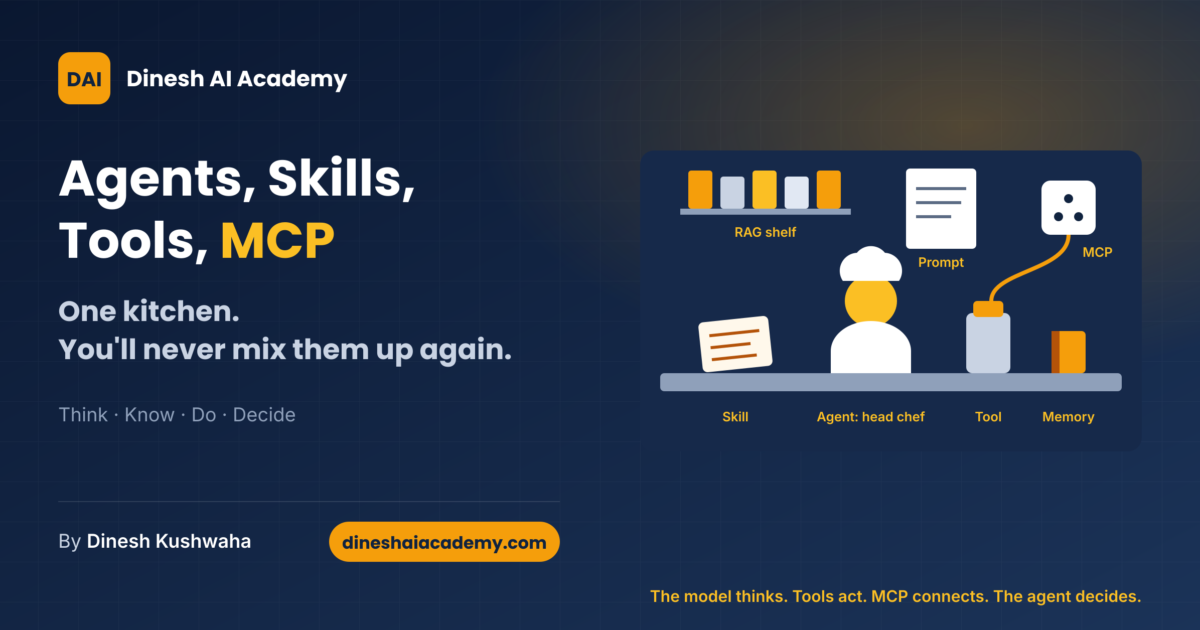
The model thinks. Tools act. MCP connects. RAG looks things up. Skills teach the method. Memory remembers. A workflow follows the plan. An agent makes the plan.
Read that line twice. Everything below is that sentence, unpacked inside one kitchen. Our kitchen belongs to a restaurant called Annapurna. It is fictional, but if you have ever eaten at a busy Indian restaurant, you already know it.
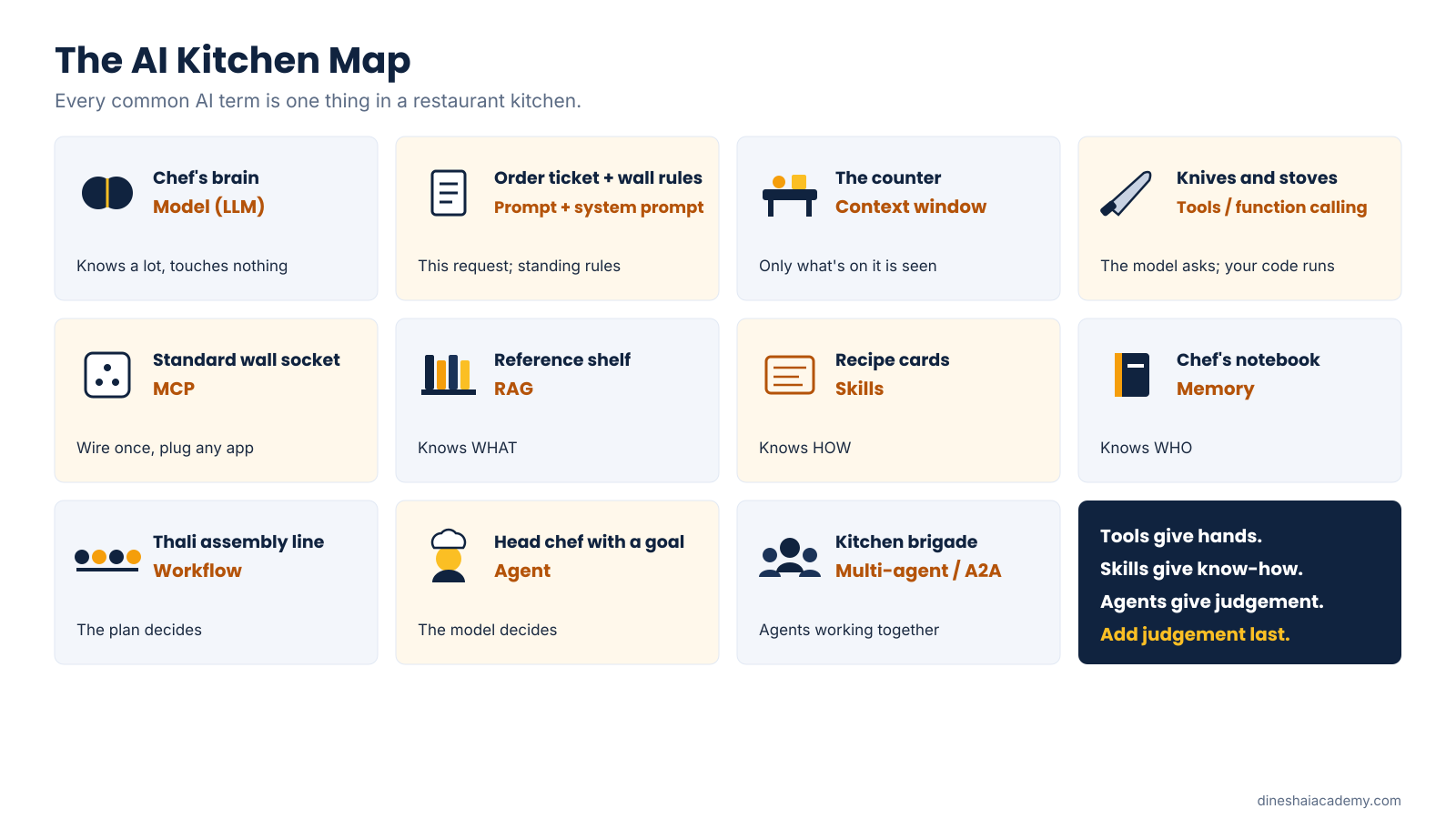
Inside the kitchen: eleven terms, eleven things you can picture
1. The model (LLM) is the chef’s brain
Our chef trained for years. She knows thousands of dishes, techniques and flavour pairings. But she has never seen this kitchen, does not know today’s orders, and has no hands of her own. A large language model is exactly that: enormous general knowledge, zero knowledge of your business, and no ability to touch anything. Left alone, it can only talk.
2. The prompt is the order ticket; the system prompt is the rules on the wall
A ticket arrives: “2 paneer tikka, less spicy, table 4.” That is the prompt: the specific request, right now. Taped to the kitchen wall are the house rules: “No peanuts in anything. Jain orders: no onion, no garlic.” That is the system prompt: standing instructions that apply to every ticket, all day.
3. The context window is the counter
The chef can only work with what is on her counter. Tickets, ingredients, notes: if it is not on the counter, for her it does not exist. Counters have grown huge. Google’s Gemini 4 Argon, for example, has a 1-million-token context window [1]. But a cluttered counter still slows a chef down, and things get lost under the pile. A bigger counter is not a substitute for a tidy one.
4. Tools are the hands and appliances
Knives, the tandoor, the weighing scale, the phone to the vegetable supplier. In AI, a tool is any function the model may ask to use: search a database, send an email, check an order. Here is the detail most people miss. The chef does not run the tandoor herself; she calls out “tandoor, 8 minutes” and the kitchen does it. In the same way, the model only requests a tool with the right inputs. Your code runs it and hands back the result [2]. This is called function calling or tool use.
5. MCP is the standard socket in the wall
Picture a kitchen where every appliance needs its own custom wiring, and every new mixer means calling an electrician. That was AI before 2024: every app-to-tool connection was hand-built. The Model Context Protocol (MCP) is the standard socket. Any appliance with the standard plug works in any kitchen with the standard socket. The official MCP site uses almost the same picture: “a USB-C port for AI applications” [3]. Build a connector to your CRM once, and Claude, ChatGPT, VS Code and other MCP-compatible apps can all plug into it [3].
Remember the difference this way: a tool is the mixer; MCP is the socket. You can own a mixer without a standard socket. The socket just means you never rewire again.
6. RAG is the reference shelf
Above the counter sits a shelf of binders: today’s menu prices, supplier contracts, the allergen chart. The chef does not memorise them. When a customer asks “does the korma contain cashews?”, she pulls the allergen chart, finds the right page and answers. That is retrieval-augmented generation (RAG): search your documents, put the relevant pages on the counter, then answer. Our practical guide to RAG goes deeper.
7. Skills are the laminated recipe cards
In a drawer are laminated cards: “Annapurna Dal Makhani: soak overnight, 6 hours on low, butter last.” On the front of each card is just the dish name. The chef glances at the fronts, and only pulls out the full card when that dish is ordered. Some cards even come with a pre-set timer.
That is an Agent Skill, almost exactly. A skill is a folder with a SKILL.md file of instructions, plus optional scripts and reference files [4]. At startup the agent reads only each skill’s name and description, the front of the card. It loads the full instructions only when a task matches, and runs bundled scripts only when needed. Anthropic calls this “progressive disclosure” and compares writing a skill to writing an onboarding guide for a new hire [5]. Skills began at Anthropic and were released as an open standard in December 2025 [5].
8. Memory is the chef’s notebook
In her apron pocket is a small notebook: “Mr Iyer, table 4, Tuesdays. Less salt. Hates coriander.” The shelf is shared and official; the notebook is personal and grows with every service. Memory is what an AI system keeps from past conversations: your preferences, earlier decisions, what happened last time. Next Tuesday, the dal arrives with less salt, and Mr Iyer never has to ask again.
RAG knows WHAT. Skills know HOW. Memory knows WHO.
9. A workflow is the thali assembly line
At 1 pm, thalis run down a line. Station 1 adds rice, station 2 dal, station 3 sabzi, station 4 sweet. Same order, every plate, nobody improvises. That is a workflow: the AI and tools follow a path written in advance. Anthropic defines workflows as systems where models and tools are “orchestrated through predefined code paths” [6]. Fast, cheap and predictable.
10. An agent is the head chef with a goal
Now the owner says: “Priya’s wedding, Saturday, 200 guests, budget ₹1.5 lakh, three Jain guests.” No ticket, no assembly line. The head chef plans the menu, checks the shelf, calls suppliers, notices paneer is short, switches two dishes, and checks the budget again. That is an agent. Anthropic’s definition: agents are systems where models “dynamically direct their own processes and tool usage” [6]. The difference from a workflow is a single question: who decides the next step? On the thali line, the plan decides. At the wedding, the chef decides.
11. Multi-agent systems and A2A are the brigade and the phone line
For the wedding, the head chef splits the work: one sous chef on the tandoor, one on desserts, each at their own counter. That is a multi-agent system (sub-agents): a lead agent hands parts of the job to specialist agents, each with its own clean context. And when the head chef phones the sweet shop across town to order 200 gulab jamuns from their manager, that is A2A (Agent2Agent): an open protocol, created by Google and now hosted by the Linux Foundation, that lets agents from different companies discover each other and work together [7].
Finally, around everything sit the guardrails: the food-safety licence, the hygiene rules and the manager who must approve any spend above ₹10,000. In AI that means permissions, limits, logging and a human approving risky actions.
The Think · Know · Do · Decide test
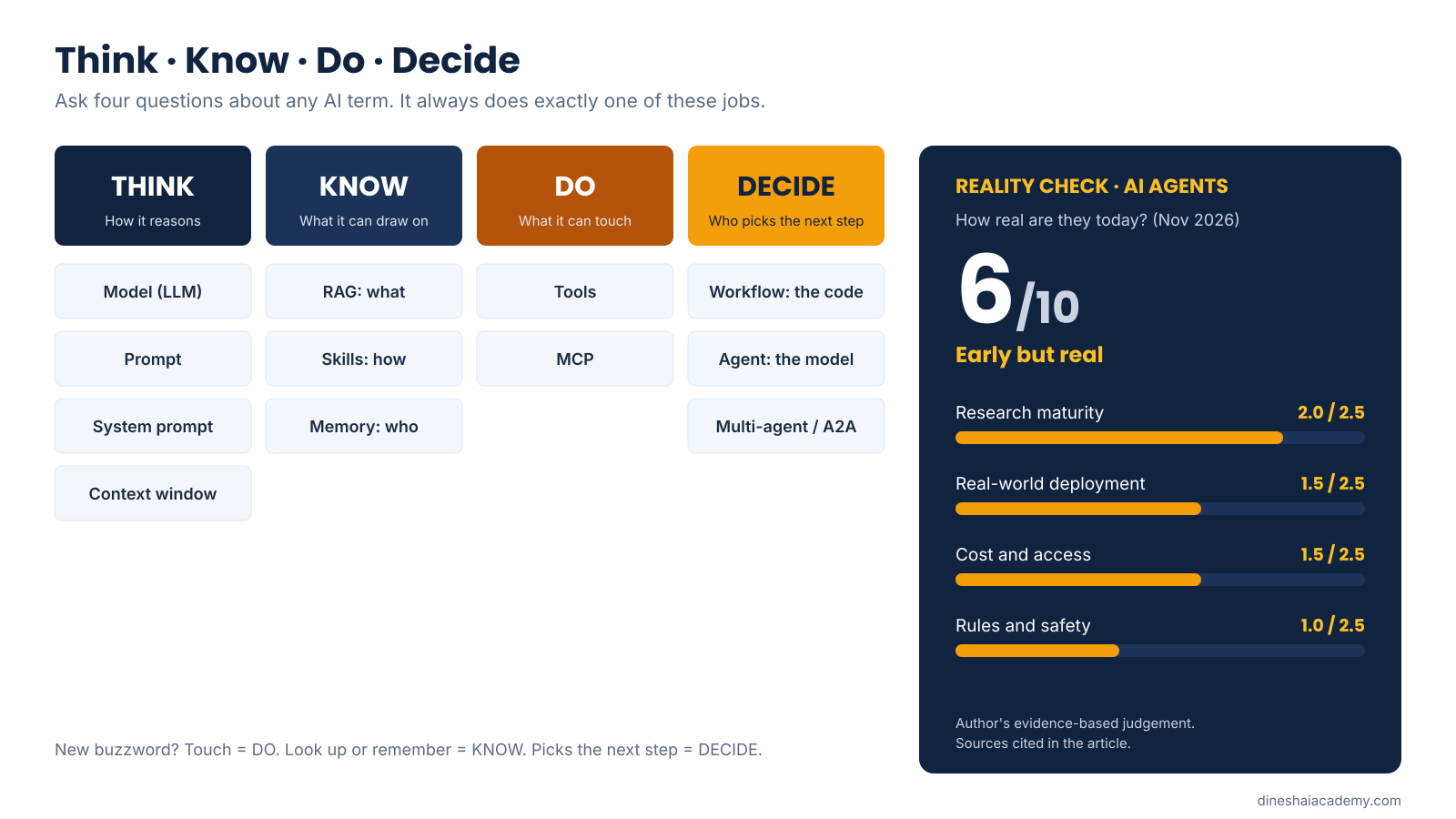
Eleven terms are a lot to hold. So here is the compression that makes them stick. Every term in AI does exactly one of four jobs. When you hear a new word, ask: does it think, know, do, or decide?
| Job | Question it answers | AI terms | In the kitchen |
|---|---|---|---|
| THINK | How does it reason and understand? | Model (LLM), prompt, system prompt, context window | Chef’s brain, order ticket, rules on the wall, counter |
| KNOW | Where does the information come from? | RAG (what), skills (how), memory (who) | Reference shelf, recipe cards, chef’s notebook |
| DO | How does it affect the world? | Tools / function calling, MCP | Knives and stoves, the standard socket |
| DECIDE | Who chooses the next step? | Workflow (the code), agent (the model), multi-agent, A2A | Thali line, head chef, kitchen brigade, phone to another kitchen |
Try it on a word you have not met yet. Next year someone will pitch you a “context engine” or an “agent marketplace”. Ask the four questions. If it changes what the AI can touch, it is DO. If it changes what the AI can look up or remember, it is KNOW. If it changes who picks the next step, it is DECIDE. The labels will change every year. The four jobs will not.
AI agents vs skills vs MCP: the six mix-ups, settled
- Tool vs MCP. The mixer vs the socket. A tool is one capability. MCP is a standard way to plug many tools into many AI apps.
- Tool vs skill. The knife vs the recipe card. A tool gives new access (now it can send email). A skill gives new method (here is how we write a refund email, which tool to use, in what order). A skill never gives access the tools do not already have.
- Skill vs prompt. Today’s ticket vs the card kept in the drawer. A prompt is one request. A skill is a reusable procedure, loaded only when a matching task arrives.
- Skill vs MCP. The recipe card vs the socket. They work together: MCP connects the AI to your CRM; a skill teaches it your company’s way of using the CRM. Anthropic describes skills as teaching agents multi-step workflows that involve external tools [5].
- RAG vs memory. The shared shelf vs the personal notebook. RAG searches documents that exist for everyone. Memory stores what this system learned from you and past sessions.
- Workflow vs agent. The thali line vs the head chef. If your code decides each step, it is a workflow, however clever each step is. If the model decides, it is an agent.
What each piece looks like in a real system.
A tool is a name, a description and an input schema that the model reads; your code holds the actual function.
{"name": "get_order_status",
 "description": "Look up the delivery status of an order by its ID.",
 "parameters": {"type": "object",
                "properties": {"order_id": {"type": "string"}},
                "required": ["order_id"]}}
A skill is a folder. Its SKILL.md starts with a name and description (the front of the card), followed by the instructions [4].
refund-handling/
├── SKILL.md        ← name + description, then step-by-step instructions
├── scripts/        ← optional code the agent can run
└── references/     ← optional policy extracts, templates

---
name: refund-handling
description: Use when a customer asks for a refund or reports a damaged item.
---
1. Look up the order with get_order_status.
2. Check the refund policy section for the product category.
3. Refunds above ₹5,000 need human approval. Never promise them.
An MCP server is a small program that exposes tools (and data) in the standard format, so any MCP client can discover and call them. An agent is a loop: the model reads the goal, asks for a tool, your code runs it, the result goes back, and it repeats until the model stops asking. A workflow is the same pieces with the order fixed in your code.
Worked example: from kitchen to customer support
Now move the picture to a real business: the support team of an Indian online store. A customer writes: “My mixer arrived broken. Order 48213. I want a refund.” Here is every term doing its one job.
| Term | What it does in this support system | Kitchen twin |
|---|---|---|
| Model | Understands the complaint and writes the reply | Chef’s brain |
| System prompt | “Be polite. Never promise refunds above ₹5,000. Reply in the customer’s language.” | Rules on the wall |
| Context window | Holds the message, order details and policy extract for this case | Counter |
| RAG | Finds the “damaged on arrival” section of the refund policy | Reference shelf |
| Memory | Recalls this customer had a late delivery last month and prefers Hindi | Chef’s notebook |
| Skill | refund-handling loads: the company’s exact steps for damaged items | Recipe card |
| Tools | get_order_status, create_return_pickup, send_email | Knives, stove, phone |
| MCP | The order system and email service are plugged in through MCP servers | Standard socket |
| Agent | Decides: check order, confirm damage photo, book pickup, draft reply | Head chef |
| Guardrail | Order value is ₹6,200, so the refund waits for a human to approve | Manager’s sign-off |
Notice what happens if you remove one piece. No RAG: the reply invents a policy. No skill: every agent improvises its own refund process. No MCP: someone hand-builds the order-system connection again for the next AI app. No guardrail: a ₹6,200 refund goes out on a model’s judgement alone.
Do you need an agent at all?
Most problems are thali lines, not weddings. Anthropic’s engineering guidance says the same: choose the simplest design that works, and move to multi-step agents only once a simpler design has proved too weak [6].
| What you need | Start with |
|---|---|
| Answers from your documents | Model + RAG |
| The same steps every time (classify, extract, route) | Workflow |
| A repeatable company method the AI should follow | Skill |
| Actions in other systems | Tools, connected through MCP |
| A goal where the steps depend on what it finds along the way | Agent, with guardrails |
No code? Many AI assistants now let you add connectors (MCP) and upload skills from a settings screen, so business teams can assemble these pieces without writing software. The concepts are identical; only the buttons differ.
Reality Map: where agents stand today
| ✅ Already done | The plumbing is standardised. MCP launched in November 2024 [8]; a year later Anthropic reported over 10,000 public MCP servers in active use and donated MCP to the Linux Foundation’s new Agentic AI Foundation, co-founded with Block and OpenAI [9]. Agent Skills became an open standard in December 2025 [5], and A2A moved to the Linux Foundation in June 2025 [7]. |
| 🔄 In progress | Enterprises are experimenting, carefully. A Nasscom survey of over 100 global enterprises found about 62% experimenting with agentic AI, and 77% building with a human in the loop; deployment remains largely incremental [10]. |
| 🔮 Possible next | Gartner predicts that by 2028 agentic AI will take at least 15% of everyday work decisions on its own, and a third of enterprise software will include it [11]. These are forecasts, not results. |
| ❌ Not possible yet, and why | Reliable, fully autonomous agents for complex goals. Gartner expects more than 40% of agentic AI projects to be cancelled by the end of 2027 because of rising costs and unclear value, and says current models lack the maturity to pursue complex goals on their own [11]. |
Milestone timeline
| When | Milestone | Status | Source |
|---|---|---|---|
| Nov 2024 | Anthropic open-sources the Model Context Protocol | Achieved | [8] |
| Dec 2024 | Anthropic publishes the workflow vs agent definitions | Achieved | [6] |
| Apr 2025 | Google launches the Agent2Agent (A2A) protocol | Achieved | [7] |
| Jun 2025 | A2A becomes a Linux Foundation project; Gartner warns of “agent washing” | Achieved | [7][11] |
| Oct 2025 | Anthropic launches Agent Skills | Achieved | [5] |
| Dec 2025 | MCP donated to the Agentic AI Foundation; Agent Skills released as an open standard | Achieved | [9][5] |
| End 2027 | More than 40% of agentic AI projects cancelled | Estimate (Gartner) | [11] |
| 2028 | Agentic AI takes 15% of everyday work decisions; a third of enterprise apps include it | Estimate (Gartner) | [11] |
Reality Check: how real are AI agents today?
| Factor | Score | Evidence |
|---|---|---|
| Research maturity | 2.0 / 2.5 | Clear, widely used design patterns exist [6], but Gartner says models still lack maturity for complex autonomous goals [11]. |
| Real-world deployment | 1.5 / 2.5 | Most enterprises are experimenting; deployment is incremental and mostly human-in-the-loop [10]. |
| Cost and access | 1.5 / 2.5 | The standards are open and free [9], but rising costs are a main reason Gartner expects cancellations [11]. |
| Rules and safety readiness | 1.0 / 2.5 | Gartner estimates only about 130 of thousands of “agentic” vendors are genuine [11], and prompt injection has no complete fix [12]. |
Reality Check: 6/10, early but real. The connectors and standards are ready. Fully autonomous agents for complex work are not. The tools, skills and MCP layers are the safest place to invest today.
Where it goes wrong (and how to fix it)
- Agent washing. A chatbot with a new label is not an agent. Fix: ask who decides the next step. If the answer is “a fixed script”, it is a workflow or a chatbot, whatever the brochure says [11].
- Hiring a head chef to make tea. Using an agent for a fixed, repeatable task adds cost and unpredictability. Fix: build a workflow first; promote to an agent only when steps genuinely depend on what is found.
- Too many tools on the counter. Fifty tools with vague descriptions confuse the model. Fix: fewer tools, sharp names and descriptions, and skills that say which tool to use when.
- A cluttered counter. Stuffing every document into the context window buries the important page. Fix: retrieve only what the task needs (RAG), and let skills load on demand.
- A notebook nobody checks. Memory can store wrong or outdated facts about a user. Fix: let users see and correct what is remembered, and expire old entries.
- An open back door. Every MCP server you plug in is new access, and text from documents or web pages can try to hijack the model. Fix: least privilege, read-only by default, and human approval for anything that spends money or changes records [12].
What it means for you
- Students: Learn the four jobs before any framework. Frameworks change every year; Think, Know, Do, Decide will still sort them.
- Engineers: Build in this order: model plus prompt, then RAG, then tools over MCP, then skills, then (only if needed) an agent loop with guardrails. Each layer should earn its place in your evaluation results.
- Leaders: When a vendor says “agent”, ask three questions. What can it touch? What does it know? Who approves its risky actions? Vague answers mean you are buying a demo.
- India: Indian firms often run on many separate systems: ERP, CRM, GST portals, WhatsApp-based support. A standard connector layer like MCP means each system is wired once for every AI app. Start there, and keep a human in the loop as most enterprises surveyed by Nasscom are doing [10].
Test yourself: which is it?
Answer each one in your head before you open it. Pulling the answer from memory is what makes it stay.
1. A file that tells the AI your company’s 7 steps for onboarding a new vendor.
Skill (KNOW, how). It is a recipe card: a reusable method loaded when that task arrives.
2. A connector that lets Claude, ChatGPT and VS Code all read your Jira tickets.
MCP server (DO). It is the standard socket: wired once, usable by any compatible app.
3. The AI remembers you prefer replies in Hindi.
Memory (KNOW, who). It is the chef’s notebook about this customer.
4. Every invoice is extracted, validated and posted in the same three steps.
Workflow (DECIDE, by the code). It is the thali line: the path is fixed in advance.
5. “Find out why sales dropped in Pune last month and propose fixes.”
Agent (DECIDE, by the model). Nobody knows the steps in advance; the head chef plans as she learns.
Dinesh’s Verdict
Most confusion about agents comes from treating every new word as a new idea. It rarely is. There are four jobs, and every product repackages them. Teams that win with AI build the boring layers first: clean knowledge, sharp tools, written-down methods. Then they give the model judgement in small, supervised steps. Teams that start with the agent usually end with a demo.
Rule of thumb: tools give hands, skills give know-how, agents give judgement. Add judgement last.
Frequently asked questions
What is the difference between an AI agent and a chatbot?
A chatbot replies to messages. An agent works toward a goal: it chooses steps, uses tools and checks results until the goal is met. If nothing is decided or done beyond the reply, it is a chatbot.
Is MCP the same as an API?
No. An API is one system’s own door, with its own rules. MCP is a standard way for AI applications to discover and use tools and data, so an MCP server often wraps an existing API in a form any MCP-compatible AI app understands [3].
Do skills replace MCP?
No. They solve different problems. MCP gives access to systems; skills give the method for using them well. Most strong setups use both [5].
Is a skill just a long prompt?
Partly, but with two big differences. A skill loads only when a matching task appears, so you can install many without filling the context window, and it can bundle scripts and reference files the agent uses when needed [4].
What is the difference between MCP and A2A?
MCP connects an AI application to tools and data: the chef to her appliances. A2A connects agents to other agents, often across companies: one head chef phoning another kitchen [7].
Can I build an agent without code?
For many internal tasks, yes. Several AI assistants let you add connectors and skills from settings. You still need the same thinking: what it may touch, what it knows, and which actions a human must approve.
Key takeaways
- Picture one kitchen: brain, ticket, counter, hands, socket, shelf, recipe cards, notebook, thali line, head chef, brigade.
- Sort any AI term with four questions: does it think, know, do, or decide?
- RAG knows what, skills know how, memory knows who. A tool is the mixer; MCP is the socket.
- Build the knowing and doing layers first; add an agent’s judgement last, with guardrails.
Build your first agent, the right way round
Concepts stick fastest when you assemble them yourself. In the 3-Day AI Builder Bootcamp you connect a model to your own documents, add tools and a skill, and only then let it act as an agent, with a mentor beside you when it misbehaves. Code and no-code paths are both covered.
References
- ↩ Google AI for Developers (2026). Models. Gemini API documentation, last updated 28 Oct 2026. https://ai.google.dev/gemini-api/docs/models (Accessed 09 Nov 2026)
- ↩ Google AI for Developers (2026). Function calling with the Gemini API. https://ai.google.dev/gemini-api/docs/function-calling (Accessed 09 Nov 2026)
- ↩ Model Context Protocol (2026). What is the Model Context Protocol (MCP)? https://modelcontextprotocol.io/docs/2026-07-28/getting-started/intro (Accessed 09 Nov 2026)
- ↩ Agent Skills (2026). Agent Skills Overview. https://agentskills.io/ (Accessed 09 Nov 2026)
- ↩ Anthropic (2025). Equipping agents for the real world with Agent Skills. 16 Oct 2025, updated 18 Dec 2025. https://www.anthropic.com/research/equipping-agents-for-the-real-world-with-agent-skills (Accessed 09 Nov 2026)
- ↩ Anthropic (2024). Building effective agents. 19 Dec 2024. https://www.anthropic.com/research/building-effective-agents (Accessed 09 Nov 2026)
- ↩ Linux Foundation (2025). Linux Foundation Launches the Agent2Agent Protocol Project. 23 Jun 2025. https://linuxfoundation.org/press/linux-foundation-launches-the-agent2agent-protocol-project-to-enable-secure-intelligent-communication-between-ai-agents (Accessed 09 Nov 2026)
- ↩ Anthropic (2024). Introducing the Model Context Protocol. 25 Nov 2024. https://www.anthropic.com/news/model-context-protocol (Accessed 09 Nov 2026)
- ↩ Anthropic (2025). Donating the Model Context Protocol and establishing the Agentic AI Foundation. 9 Dec 2025. https://www.anthropic.com/news/donating-the-model-context-protocol-and-establishing-of-the-agentic-ai-foundation (Accessed 09 Nov 2026)
- ↩ Entrepreneur India (2025). Majority of Enterprises have Dedicated AI Budgets with 62% Experimenting with Agentic AI: Nasscom. 1 Jul 2025 (reporting Nasscom, “Enterprise Experiments with AI Agents – 2025 Global Trends”). https://india.entrepreneur.com/news-and-trends/majority-of-enterprises-have-dedicated-ai-budgets-with-62/494075 (Accessed 09 Nov 2026)
- ↩ Reuters, via The Star (2025). Over 40% of agentic AI projects will be scrapped by 2027, Gartner says. 25 Jun 2025. https://www.thestar.com.my/tech/tech-news/2025/06/25/over-40-of-agentic-ai-projects-will-be-scrapped-by-2027-gartner-says (Accessed 09 Nov 2026)
- ↩ OWASP Gen AI Security Project (2025). LLM01:2025 Prompt Injection. https://genai.owasp.org/llmrisk/llm01/ (Accessed 09 Nov 2026)
Image credits: All illustrations and diagrams are original work by Dinesh AI Academy. Annapurna is a fictional restaurant, and the support example is illustrative.
Last updated: 9 November 2026